Contrada Contro 2023: the Marche Trebbiano that grows up trees
Old-vine Trebbiano married to maple trees below the Sibillini mountains. It smells of bananas, tastes of flint and carries a deliberate oxidative streak.
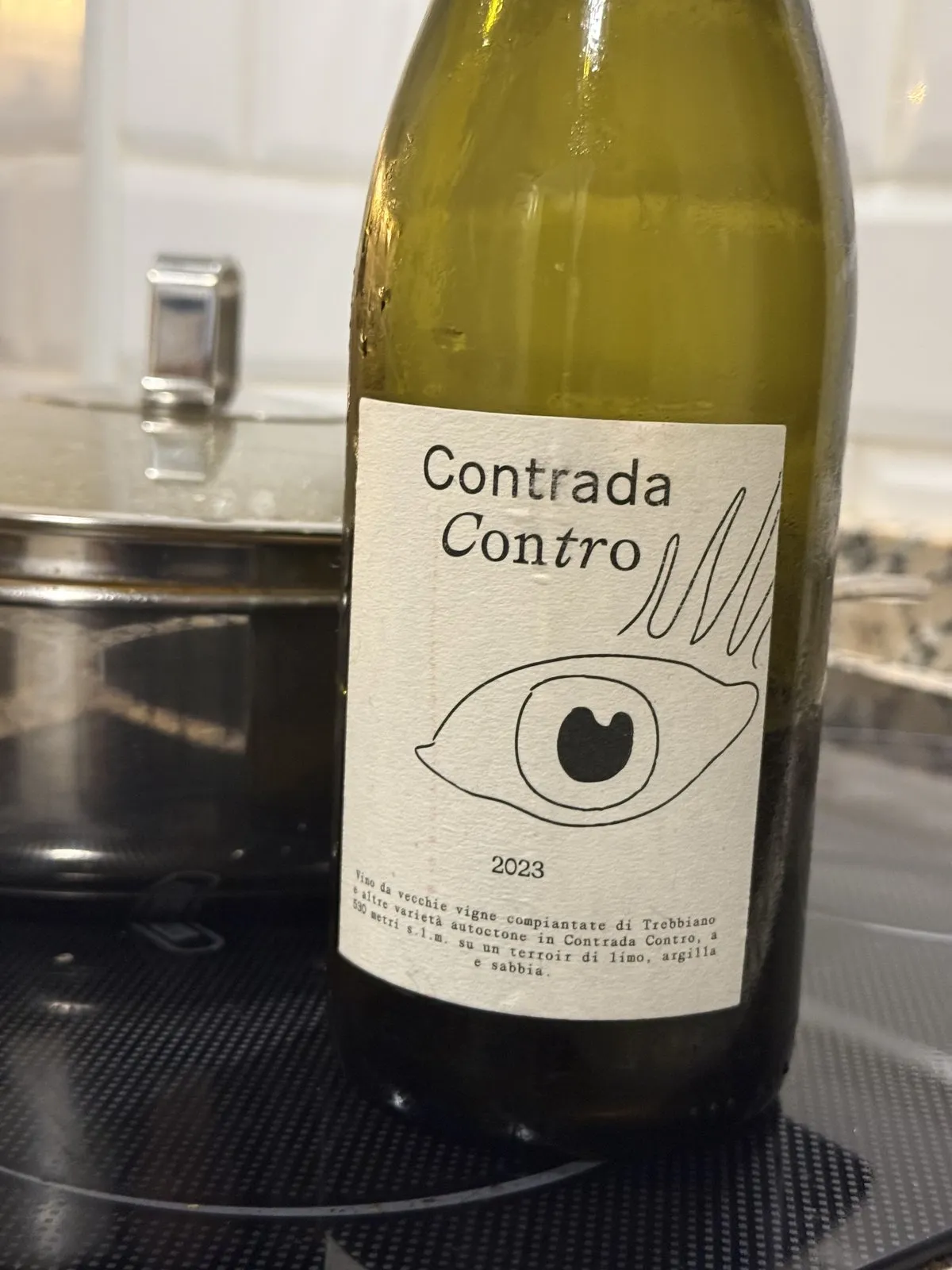
The other day we opened a Contrada Contro 2023 (@contradacontro). It had been on my radar for ages, one of those bottles you keep walking past and never quite commit to. Then @javrivc recommended it and I took the plunge. No regrets whatsoever.
It’s from the Marche, in central Italy, on the Adriatic side. And it’s made from Trebbiano, a grape which, now I come to think of it, I don’t believe I’d ever tried. Not knowingly, anyway.
Vines married to maples: the vite maritata
The real discovery with this bottle isn’t in the glass, it’s out in the field. These vines don’t grow on wires or as bush vines: they climb maple trees. The vine heads up the trunk and spreads through the branches, and the vineyard ends up looking more like a wood than anything else.
It has a name, and a lovely one: vite maritata, the married vine. The idea goes back to the Etruscans, the Romans picked it up, and for centuries it was simply how vines were grown in central Italy. A farmer would plant a young maple, wait for it to take, dig a deep hole beside it and drop in a cutting from the neighbour’s vine. Then came the waiting: a farming manual from 1913 reckons seven years before the vine was properly productive. Wheat or maize went in between the trees, with cherries and olives dotted around. A whole farm pulling in the same direction.
After the Second World War the tractors arrived, and vines planted ten metres apart became a nuisance. In the sixties and seventies the authorities were actually paying farmers to rip them out and replant modern vineyards. Almost all of it went.
Almost. Behind this bottle is Andrea Polidoro, winemaker at Cupano in Montalcino, who in March 2020 set about rescuing the old vines on his grandfather’s land at the foot of the Monti Sibillini. Old vines, some over a century, all ungrafted, abandoned for years and tangled up into the canopy with their maples. He pruned them back by hand, two or three vines a day. He swears by the maple as the perfect partner: it bears no fruit to compete with the grapes, its early leaves shield the buds from birds and hail, and its taproot heads straight down without fighting the vine’s roots.
The label sums it up in a line: old interplanted vines of Trebbiano and other native varieties, in Contrada Contro, at 530 metres, on silt, clay and sand. With that little clay, phylloxera struggles, and Polidoro says he has never seen it there. It reminded me of home: in the Canaries we have our own one-of-a-kind way of training vines, the braided cordon of La Orotava, and vines still on their own roots because nobody ever had to graft them.
Trebbiano, the grape with a reputation for being dull
Confession: if you’d said “Trebbiano” and nothing else, I wouldn’t have bothered. It’s one of Italy’s most planted white grapes and has a name as a workhorse, all volume and little charm. In France they call it Ugni Blanc and nearly all of it ends up in the still, on its way to becoming Cognac. Not a grape anyone goes looking for.
But this happens a lot: the reputation belongs to the grape when it’s farmed for bulk. Old vines, no bunch thinning, wild-yeast ferments, and it’s a different story altogether. Much like Viura, come to think of it.
Tasting notes: a banana warehouse on the nose, flint on the palate
Pale gold in the glass. And on the nose it’s like a wander round Coplaca, the big banana cooperative back home in the Canaries: bananas everywhere, the smell of their packing sheds exactly. Behind the banana there’s a bit of peach and lemon peel, which is what keeps it from getting heavy.
On the palate there’s a little mineral edge, flinty, like the spark off a lighter, a dry flash that lingers on the tongue. And a trace that struck me as oxidative, though in my Instagram post I didn’t quite dare put my name to it. Turns out I was right: The Wine Society, which sells it in the UK, mentions “a degree of deliberate oxidation”. That background note, somewhere between nuts and ripe fruit, isn’t a fault, it’s the house signature. If that register is your thing, the Monopole Blanco Seco Reserva and Mirando al Sur play in the same league, each with its own trick.
It’s very much a low-intervention wine: wild yeasts, no make-up and around 12% alcohol that you don’t notice. It goes down dangerously easily.
What to drink it with?
Shellfish and pasta. That ripe fruit and oxidative undertow want something with flavour: garlic prawns, spaghetti alle vongole, a creamy seafood risotto. A semi-cured cheese works too (here’s our guide to wine and cheese). What I wouldn’t do is serve it ice-cold: just under cellar temperature, then let it open up in the glass.
The first bottle I opened on a tip-off. The second I’ll open out of sheer greed.
A stunner. So much so that I have already bought another.