Lanzarote wine: why La Geria tastes like nowhere else
Vines in pits on volcanic ash, saline Malvasía and a streak of acidity you never see coming. An honest guide to why Lanzarote wine, and La Geria, tastes different.
22 July 2026
Last August I put my son up on my shoulders and we went for a walk through the pits of La Geria. We were on a family trip with a couple of friends, and one afternoon we ended up at Casa Althay, a small winery with a guesthouse right in the middle of the valley. The first thing that hits you isn’t the wine: it’s the silence. A strange sort of silence, with the wind rushing underneath it and the volcanic grit crunching under your feet. Everything dry, everything salty, that air that sticks to your lips.
Out in the middle of the black field stood a huge fig tree, a green so loud it seemed to shout at the ash, planted in its own pit like just another vine. I pulled off a fig and ate it right there: sweet, soft, ripe, warm from the sun. Honestly, it was ridiculous.
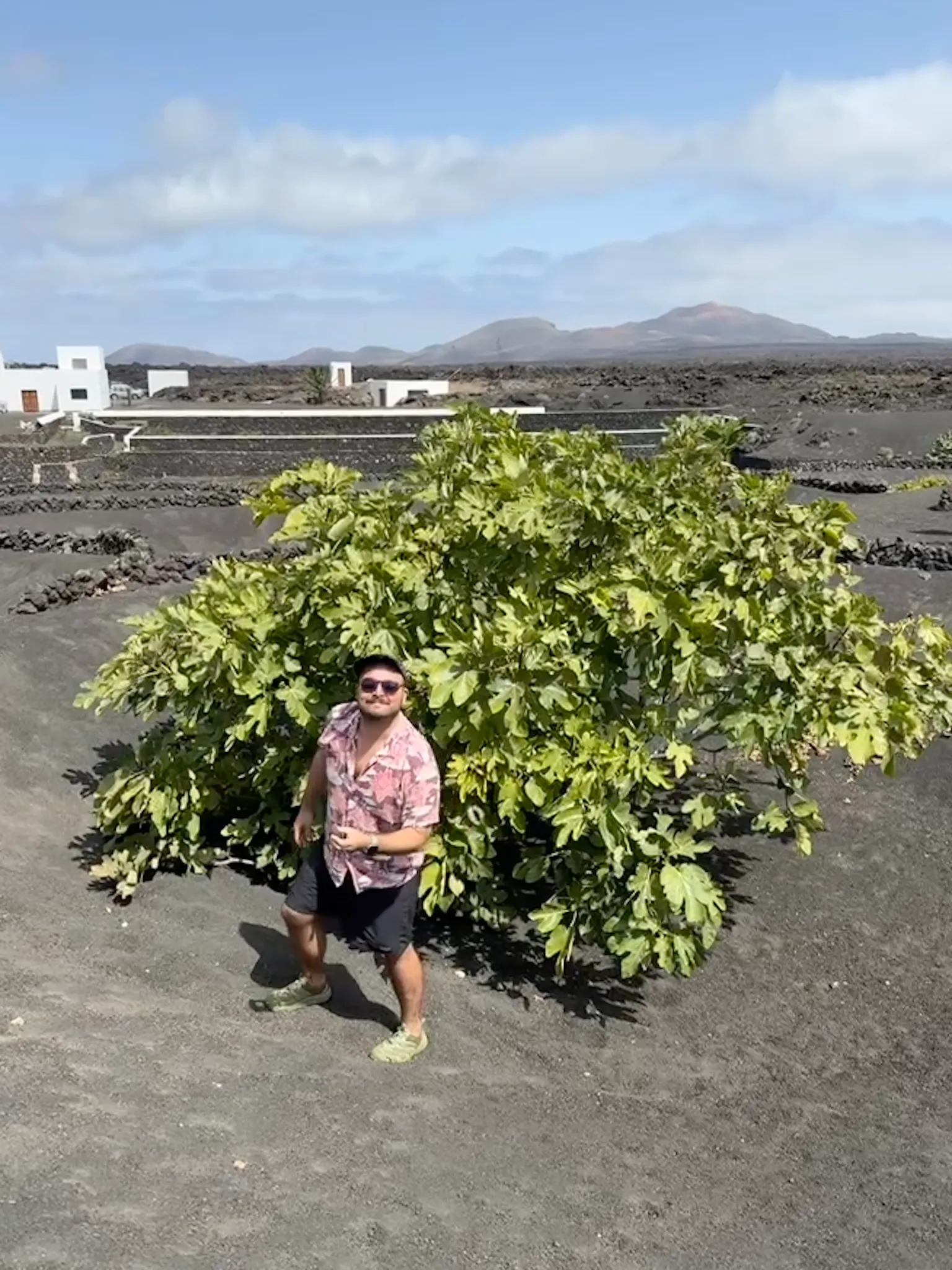
That’s when it clicks. Lanzarote isn’t the beach island the brochure sold you, and the wine that comes off it doesn’t taste like anything else either. That’s why La Geria tastes different, and this guide is about exactly that: why.
How you plant a vine on a volcano
Timanfaya went off between 1730 and 1736. Six years of eruptions, the longest in the recorded history of the Canaries, that buried nearly a quarter of the island under a blanket of ash. Where there had been farmland, there was now a black desert of lapilli, known here as picón or rofe. It looked like the end of agriculture. It turned out to be the opposite.
Someone worked out that the picón behaved like a sponge: overnight it traps the dew and the moisture the trade winds carry in, holds onto it and feeds it slowly down to the roots. On an island where it barely rains and nothing is irrigated, that’s gold. So they started digging pits, sometimes two or three metres down, until they reached the good soil buried underneath, planting the vine at the bottom and covering it back up with ash. And around each pit, a zoco: a low half-moon wall of volcanic stone that breaks the constant north-easterly wind.
The result is a landscape that looks like no other vineyard on earth: miles of craters with a single vine at the bottom of each, lined up across the ash. La Geria runs to more than 5,000 hectares like this. The Lanzarote DO has protected it since 1993. And because the Canaries never had phylloxera, plenty of these vines are ancient and ungrafted, growing on their own roots straight into the ground. No small thing.
Malvasía Volcánica: salt, stone and an acidity you don’t see coming
Of everything planted on Lanzarote, close to 70% is Malvasía Volcánica, and it isn’t your usual Malvasía. It’s a natural cross, born in the Canaries, between Malvasía Aromática and Marmajuelo. The surname doesn’t lie: it tastes of the volcano. Salt, wet stone, white flowers, and underneath it all an acidity that holds the wine up even when it’s bone dry and you’re sitting in thirty degrees of shade.
That’s what’s got me hooked. Lanzarote whites are some of my favourite whites full stop, and it’s down to that effortless elegance, like they aren’t even trying: fresh, saline, long, no oak and no fireworks. A good one doesn’t need anything else. (We’ve given it a whole guide: what Volcanic Malvasía is and how it tastes.)
It’s not all white, mind you. Listán Negro makes light, spiced reds built to drink chilled (a red with more faces than you’d think), and you’ll also come across Diego, Moscatel and the odd Listán Blanco. But if you’re here to understand Lanzarote, you start with the Malvasía.
Why does Lanzarote wine taste different?
It tastes different because of three things that rarely line up in one place: the volcanic ash the vine grows in, the salinity of an Atlantic wind that never lets up, and old ungrafted vines that never went through phylloxera.
Add a genuinely dry climate, no irrigation, where the vine struggles and concentrates, plus the natural acidity of Malvasía Volcánica holding it all together. This isn’t marketing or a pretty label: there is, quite literally, nowhere else where all of that comes together at once. The wine tastes of the place. Full stop.
Where to start: five wineries to get you in
- El Grifo — The oldest winery in the Canaries (founded 1775) and one of the oldest still standing in Spain. They’ve even got a museum, with the original press. Their Malvasía is the classic way in and it never lets you down.
- Los Bermejos — Another benchmark. Their dry Malvasía is textbook, and they make a brut nature sparkler, 100% Malvasía Volcánica by the traditional method, that’s well worth chasing down.
- Titerok-Akaet — The ones recovering old vines up north, in Haría. AKAET for the whites, TITEROK for the reds, all organic and with very little sulphur. Wine with a name and a face.
- Casa Althay (Volcán del Sol) — The one we visited. Small, family-run, tucked into the valley. We tasted the usual suspects off their list and also something that hadn’t been released yet: a sparkling wine they’d disgorged that very morning. A proper treat to catch it like that, only just woken up.
- Cohombrillo — A tiny family project, vines up to two hundred years old on their own roots, natural and made in minuscule quantities. If you find it, grab it without a second thought.
When we review specific bottles from the island we’ll link them here so you can go straight to them. In the meantime you know the drill: if you spot a Lanzarote Malvasía out there, don’t hesitate.
And if Lanzarote is your first stop in Canary wine, the full map of the archipelago is in where to start with Canary Islands wine: what to expect, in what order, and why it costs what it costs.
Lanzarote whites are some of my favourites and picking just one is a nightmare. Like that fig tree: they survive where nothing has any business surviving, and they taste better for it.
- Malvasía VolcánicaVolcanic Malvasía: what it is and how it tastesA Canary-born cross of Malvasía Aromática and Marmajuelo, found nowhere else on earth. What Volcanic Malvasía is, how it tastes, and how it went from Shakespeare's wine to dry.
- Malvasía VolcánicaCanary Islands wine: where to start without getting lostVolcanic soil, grapes that exist nowhere else and a ladder that starts in a guachinche. How to get into Canary Islands wine without drowning in eleven appellations.
- Listán NegroListán Negro: the Canary red that changes its faceThe most planted red in the Canaries isn't one thing: it runs from light, fresh carbonic to serious oak-aged. What Listán Negro is and how to drink it.
- Canary IslandsTodos Blanco 2024: the Gran Canaria white you'll struggle to find306 bottles of a Gran Canaria white made from listán blanco, malvasía, vijariego and muscat. Light, easy, with an oxidative edge that shows up without taking over.
- Canary IslandsLorelay Toto 2024: a debut orange wine from Listán Blanco at 1,400 metresThree months on skins, ungrafted pre-phylloxera vines in Güímar and 386 numbered bottles. Starting a project on the top rung of the Canary Wine pyramid.
- Canary IslandsLos Loros La Bota de Mateo 2024: the Güímar Listán Blanco that turns up with an Andalusian accentUngrafted Listán Blanco from the Valle de Güímar, aged in an old manzanilla cask. Top marks from Tim Atkin and an Andalusian accent you never see coming.