Canary Islands wine: where to start without getting lost
Volcanic soil, grapes that exist nowhere else and a ladder that starts in a guachinche. How to get into Canary Islands wine without drowning in eleven appellations.
6 August 2026
My first Canary wine was in a guachinche, and I have no idea what it was. That’s rather the point: nobody introduced it. You turned up with the family, there was one long table, out came the papas and the carne fiesta, and with the food arrived a jug of the house wine. A fruity white, a touch sweet, tasty, fruit right up front and not a single pretension on it. It was the owner’s own harvest. Full stop.
(A guachinche, if you’ve never met one, is a Tenerife institution: a family place that opens for part of the year to sell the wine the owner made themselves, with home cooking alongside. It’s written into Canary law, Decree 83/2013, which tells you how seriously people take it here.)
That white appears in no wine guide and probably wouldn’t survive a blind tasting. But it’s where everyone here starts, and years later I’ve worked out it’s also the best place to start. Not out of nostalgia: because it teaches you the right order.
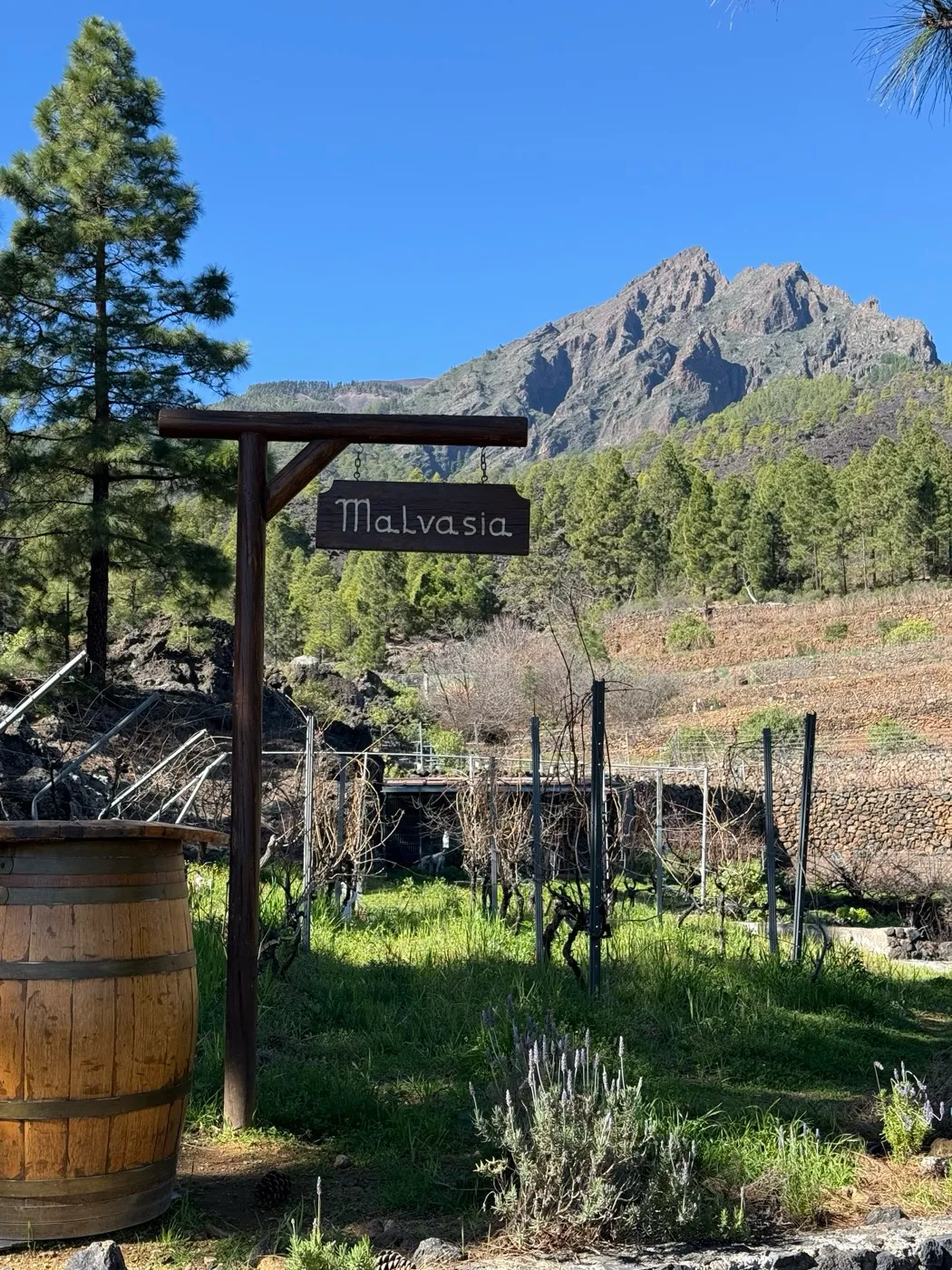
If you’re getting into the wines from here and you’ve gone looking for information, you’ll have hit the mess already: eleven appellations, grapes you’ve never heard of, prices higher than you expected, and everybody repeating the word “volcanic”. This guide is about sorting that out. It isn’t a list of bottles to copy (we’ll do that one separately). It’s what I wish someone had told me before I started buying.
The rules of mainland Spanish wine don’t apply here
That isn’t a nice line to sell you the islands. It’s literal, and there’s a physical reason for it.
The soil. Vines here grow in ash, in volcanic grit, in old lava flows. There’s nothing like it in the rest of Spain: not on the mainland, not in the Balearics, which are islands too and have their own character but don’t have a volcano underneath. That soil isn’t scenery, it’s what makes the wine. It holds the night’s moisture, drains like nothing else, and gives the wine a mineral, saline tension that comes from neither the grape nor the barrel. It comes from down there.
And the roots. The Canaries escaped phylloxera for more than five centuries, the plague that wrecked European vineyards in the 1800s and forced the whole continent to graft its vines onto American rootstock. Here it wasn’t needed. Plenty of vines still grow ungrafted, on their own roots, with varieties Europe lost and these islands never did.
I say “escaped” in the past tense on purpose. In August 2025 phylloxera was found in Tenerife for the first time: 89 positives that year and four more in 2026, nearly all in abandoned plots, centred on the Tacoronte-Acentejo area. The islands are in the eradication phase and, if it works, they’d be the first region in Europe to pull it off. I mention it because you’ll read in a hundred places that “the Canaries have never known phylloxera”, present tense, and that’s no longer quite right. For now the ungrafted old vines are still there, and long may that last.
What does Canary Islands wine taste like?
Saline, mineral and alive. That’s the short answer: far more acidity and far more tension than anyone used to mainland Spanish wine is expecting, with a salty undertow that seems to come off the sea and a stony note that comes from the ground.
These are wines with nerve. Sometimes a bit aggressive, and I mean that as a compliment: they aren’t friendly from the first sip, they haven’t come to be liked. A white from here is not a Rueda or a white Rioja, and if you open one expecting that you’re in for a shock. The shock is the good bit. The first time I pour a Canary wine for someone from off the islands, the face is always the same: they weren’t expecting that.
They’re also wildly different from each other, which is the confusing part. A white from Lanzarote and one from northern Tenerife have almost nothing in common beyond the archipelago. Which is why the next bit matters so much.
The guachinche ladder: how to climb it
This is the useful part. It’s the real order in which people learn to drink here, the one I followed without knowing I was following it, and it works because each rung sets your palate up for the next.
1. The fruity white. Start here. A young Listán Blanco, fruit forward, sometimes with a touch of sugar left in. Easy, tasty, drink it without thinking. Don’t look down your nose at it: it’s the most planted grape in the islands and an honest starting point.
2. The dry white. The same Listán, but done properly, or a Volcanic Malvasía from Lanzarote. The sugar drops away and everything else shows up: the salt, the stone, the acidity that holds the wine together even at thirty degrees. This is the rung where people genuinely get hooked. If you only ever try one Canary wine, make it this one (we’ve a whole guide on what Volcanic Malvasía is and how it tastes).
3. The young red. Listán Negro, served cool, pale in colour and light in body. You’ll find it lighter than a red “should” be, with an odd smoky edge that doesn’t come from oak. It’s a red with more faces than you’d think, and it takes a chill without complaining.
4. The oaked red. And from there on to barrel-aged reds, single-parcel wines, the odd stuff. By the time you get here your palate is built and you can tell what the place is doing from what the winemaker is doing.
Don’t skip rungs. Start at the top, with the rare expensive bottle someone recommended, and you’ll miss exactly what makes this worth doing.
Forget the appellations at first: look at the grape and the island
The Canaries have eleven denominations of origin, which for an archipelago this size is frankly ridiculous. Ten are island or valley DOs: five on Tenerife alone (Abona, Tacoronte-Acentejo, Valle de Güímar, Valle de La Orotava and Ycoden-Daute-Isora) and five more across Lanzarote, La Palma, Gran Canaria, La Gomera and El Hierro. Then there’s DOP Islas Canarias, created in 2012, covering the whole archipelago.
Here’s the misunderstanding half the internet is carrying: that last one is not an umbrella over the other ten. It’s one more appellation, with its own rules, sitting alongside them. Each winery decides which one it bottles under. Which is why you can find two wines made in the same valley, from the same grape, a kilometre apart, carrying labels that look nothing alike. It’s now the biggest denomination in the islands: 54 wineries, 817 growers and around 621 hectares.
So what should you do with all that? Nothing, at first. Genuinely. Look at the grape and look at the island, in that order, and leave it there.
The island tells you more than the appellation does. Lanzarote has a recognisable line, saline and sharp, that holds whether a vineyard sits high or low (why La Geria tastes different). Tenerife is another story altogether: a 3,718-metre volcano in the middle and five denominations around it, on slopes with nothing in common. You’ll pick the DOs up on your own, with time and bottles. They’re the last thing you need, not the first.
Why is Canary Islands wine so expensive?
Because a hectare here yields far less fruit than anywhere else in Spain. That’s the reason, and there’s no trick to it.
The numbers say it better than I can: in Rioja a hectare might give 6,000 to 9,000 kilos of grapes. In the Canaries, 1,000 to 1,500. Same land, same year of work, a fraction of the wine. Add that harvesting is done by hand out of necessity (no machine is getting into a pit dug in volcanic grit, or up a terraced slope) and that working a hectare can run to 5,000–7,000 euros depending on the area.
So I’m not going to sell you this as a bargain hunter’s paradise. Canary wines are expensive on average, and rightly so. I’d rather tell you now than have you find out at the till and assume you’re being fleeced. What I will say is that what’s in the bottle doesn’t taste like anything else, and that, to me, is what you’re paying for.
The mistake everyone makes at the start
I made two, and I watch people make them constantly.
The first: buying by the label. I never looked at the appellation, and no harm done there, but I also had no idea what to expect. I’d grab whichever bottle looked best and see what happened. The shortcut is above: grape, island, and dry or fruity. Those three will serve you better than any gold medal on the back label.
The second, and this is the big one: sticking to the established wineries. The classics make perfectly good wine and they’re a respectable way in. But what’s actually happening in the Canaries right now is in the small projects: people making tiny runs from plots nobody else wants because nobody else can work them. That’s where the surprise lives.
Names to pull the thread with, island by island
Before the list, let’s be clear about what it isn’t: not a ranking, not the only ones worth drinking, and certainly not a closed list. These are the ones in my head as I write this, and I’m leaving out plenty of people doing it just as well or better. They’re here so you’ve somewhere to start looking.
- Lanzarote — Los Bermejos, Titerok-Akaet and Cohombrillo. All three work Volcanic Malvasía, and all three taste of that island and nowhere else.
- Tenerife — Suertes del Marqués, in the Valle de La Orotava, who since 2006 have done more than anyone to put the island on the map. Envínate, with their vines in Taganana, where the harvest comes out on horseback because there’s no other way to get it out. Then Tajinaste, Viñátigo, Arautava, Alejandro Gallo and Ambora. And in the Valle de Güímar itself, Iñaki Garrido, an engineer who came over from the mainland, fell for the place, and now makes Las Toscas off half a hectare of ungrafted Listán Blanco between 150 and 200 years old, up at Las Dehesas at 1,400 metres.
- La Palma — Victoria Torres, fifth generation of a growing family, making the wines the way her father made them. Michael Candelario, in Puntagorda, fourth generation and one of the youngest cellars on the island. And Llanos Negros, in Fuencaliente, with ungrafted wines made the way they used to be.
- El Hierro — Bimbache.
- La Gomera — Lomito del Cura, a family outfit behind El Puntalito, an ancestral-method sparkling.
- Gran Canaria — Tamerán, the project David Silva (yes, the footballer) set up with Jonatan García of Suertes del Marqués. And Todos, three friends with a mountain estate and minuscule runs: their Blanco 2024 came to 306 bottles.
Two we’ve already reviewed, both from the Valle de Güímar, both Listán Blanco, so you can see how far apart they land: Lorelay Toto 2024 is an orange wine off a parcel at 1,400 metres that made 386 bottles, and Los Loros La Bota de Mateo is a white raised in an old manzanilla cask that comes out speaking Andalusian. Same grape, same valley, same municipality even. Not remotely alike.
So where do I actually start?
To recap, and with no specific bottles because you don’t need them yet:
- Start with a dry white, Listán Blanco from Tenerife or Malvasía from Lanzarote. That’s the rung where it clicks.
- Don’t pay for the appellation. Grape and island.
- Accept the price. Between 12 and 20 euros there’s a lot of very good wine, but don’t go hunting the six-euro Canary bottle that beats everything, because there isn’t one.
- Once you’ve got the taste, go looking for the small projects. That’s the stuff you haven’t tried.
- And if you’re lucky enough to be here, get yourself into a guachinche. Start where the rest of us started.
These wines taste like home to me, so I’m hardly impartial and I know it. But they’re also the ones with the greatest capacity to surprise anybody, and that part I’m not making up: I see it every time I pour one for someone who doesn’t know them and they come up out of the glass with an eyebrow raised.
Start with the fruity one at the guachinche. You’ll climb.
- Malvasía VolcánicaVolcanic Malvasía: what it is and how it tastesA Canary-born cross of Malvasía Aromática and Marmajuelo, found nowhere else on earth. What Volcanic Malvasía is, how it tastes, and how it went from Shakespeare's wine to dry.
- Malvasía VolcánicaLanzarote wine: why La Geria tastes like nowhere elseVines in pits on volcanic ash, saline Malvasía and a streak of acidity you never see coming. An honest guide to why Lanzarote wine, and La Geria, tastes different.
- Listán NegroListán Negro: the Canary red that changes its faceThe most planted red in the Canaries isn't one thing: it runs from light, fresh carbonic to serious oak-aged. What Listán Negro is and how to drink it.
- Listán BlancoTodos Blanco 2024: the Gran Canaria white you'll struggle to find306 bottles of a Gran Canaria white made from listán blanco, malvasía, vijariego and muscat. Light, easy, with an oxidative edge that shows up without taking over.
- Listán BlancoLorelay Toto 2024: a debut orange wine from Listán Blanco at 1,400 metresThree months on skins, ungrafted pre-phylloxera vines in Güímar and 386 numbered bottles. Starting a project on the top rung of the Canary Wine pyramid.
- Listán BlancoLos Loros La Bota de Mateo 2024: the Güímar Listán Blanco that turns up with an Andalusian accentUngrafted Listán Blanco from the Valle de Güímar, aged in an old manzanilla cask. Top marks from Tim Atkin and an Andalusian accent you never see coming.