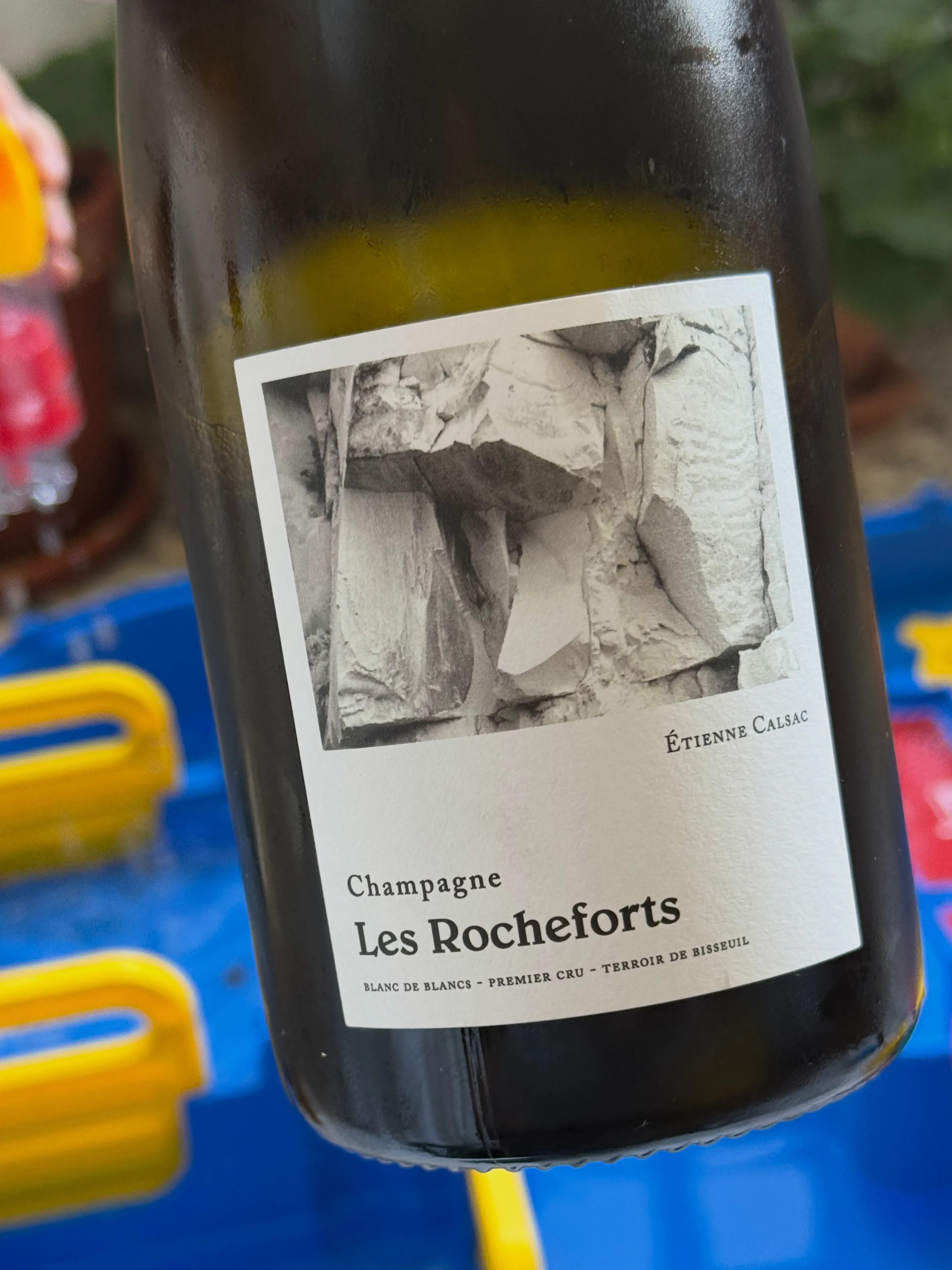
Étienne Calsac's Les Rocheforts: the Blanc de Blancs cut from pure Bisseuil chalk
A Blanc de Blancs off pure chalk from a young Avize grower. Knife-edge acidity, a whiff of fresh-cut grass and the toast only long lees ageing gives.
A few days back we opened Étienne Calsac’s Les Rocheforts, a Blanc de Blancs off the pure chalk of Bisseuil. One of those Champagnes you open expecting something good and it still catches you out.
Because this isn’t fizz for the toast and not much else. It’s about place, about chalk, and about an acidity that cuts.
A kid, his grandparents’ vines, and a lot of chalk
Étienne Calsac set up shop in 2010, taking back the three hectares his grandparents held in Avize, deep in the Côte des Blancs, which until then had been rented out to the big houses. He’s now one of the most talked-about names in the area, and rightly so.
He farms biodynamically, every plot certified organic since 2021, with wild ferments, ageing in wood and steel, no fining or filtering and sulphur kept to the bare minimum. The polar opposite of supermarket-shelf fizz, in other words.
Les Rocheforts (roughly, “the strong rocks”) is his odd one out: a single vineyard not in the Côte des Blancs but in Bisseuil, a Premier Cru better known for Pinot Noir. A Blanc de Blancs, 100% Chardonnay, off pure chalk. Exactly what lands in your glass before you’ve even glanced at the back label.
The tasting: a knife with manners
On the nose there’s that knife-edge acidity and something green I’d swear is fresh-cut grass (might be making it up, but there it is). A fine little fleck of white pepper turns up too, giving it a wild streak.
And on the palate, that warm toasted-bread note you take for granted in a Champagne this good and are still chuffed to find. That toast doesn’t come from nowhere: it’s the lees ageing and the perpetual reserve Étienne’s kept going since 2012, autolysis doing its slow work. It’s an Extra Brut, barely any added sugar, so there’s nothing to hide behind: the chalk and the acidity come straight at you.
What to drink it with?
Anything calling for freshness and salt. A Champagne this dry and sharp is a forever-aperitif: oysters, good ham, grilled prawns, a plate of fried fish. It’ll take mild cheese too and, at a push, papas with mojo (the green one, so it doesn’t scrap with the acidity). Honestly though, it’s best on its own, letting the chalk do the talking.
The sort that turns you into a fan of a whole house in one sitting.
A cracker, like everything I've tried from these folks.