Los Loros La Bota de Mateo 2024: the Güímar Listán Blanco that turns up with an Andalusian accent
Ungrafted Listán Blanco from the Valle de Güímar, aged in an old manzanilla cask. Top marks from Tim Atkin and an Andalusian accent you never see coming.
Tim Atkin only just handed this wine top marks. Plenty of people will know that already, but a perfect score still catches me off guard every time, because from the little I’ve tried (and it really is little) they’re wildly different wines. I like not knowing what to expect.
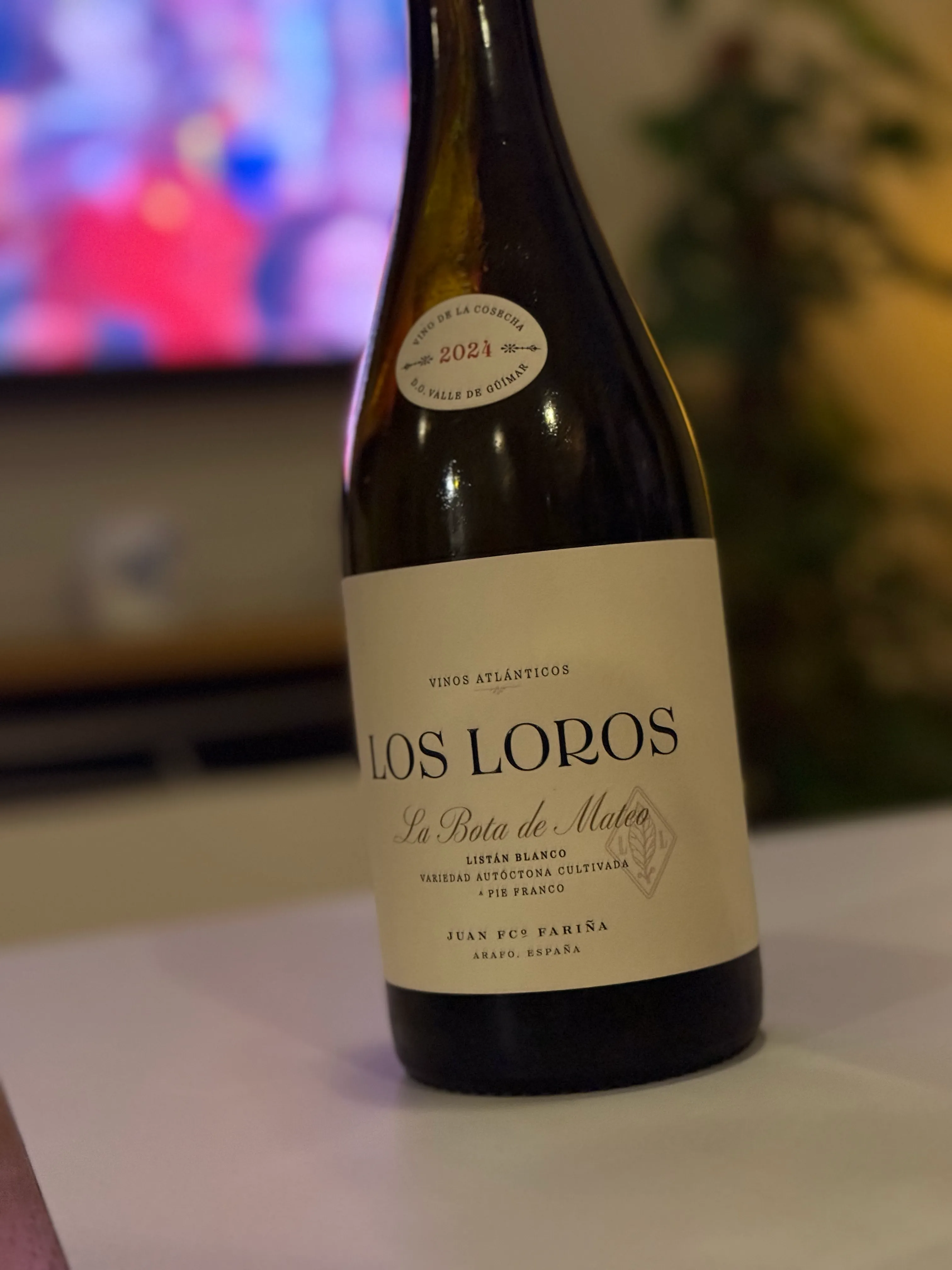
And this one delivers: Los Loros La Bota de Mateo 2024, from Juan Francisco Fariña, a Listán Blanco from the Valle de Güímar unlike any Canary Islands white you’ll have tried.
A Listán Blanco raised inside a sherry cask
The name isn’t just for show: La Bota de Mateo is aged inside an old sherry cask, the kind that used to hold manzanilla. It never quite grows a veil of flor, but it comes out with the Andalusian accent stuck to it, like when you spend a weekend in Cádiz and come back in a bit of a muddle.
Behind the bottle is Juan Francisco Fariña, JuanFra to most, who’s been quietly making wine in the Valle de Güímar since the early 2000s. His project is called Los Loros, after the laurels that grow in the upper reaches of the valley. He works the hard plots: ungrafted Listán Blanco on century-old, high-altitude vines you can only reach with a kitted-out tractor, and that yield next to nothing.
He isn’t the only one round here doing odd things with Güímar Listán: the Lorelay Toto 2024 is an orange wine off a plot at 1,400 metres, and it lands on a similar peach skin by a route that has nothing in common with this one.
And there’s a lovely coincidence buried in all this. Listán Blanco is the same grape they call Palomino in Jerez, the one behind the finos and the manzanillas. So when JuanFra tucks it into an old manzanilla cask, the family resemblance shows up on its own: the grape sneaks back home through the side door.
The tasting: peach skin and an acidity you don’t see coming
From that cask comes a caramelised, faintly oxidative edge that has you looking twice at the glass. Peach skin, with the velvet of that fuzz that scratches your teeth a little before you bite in. And then, just when you’d surrendered to the wrapping, an acidity you weren’t expecting turns up.
On the palate it’s soft and subtle, but with a magic it never quite explains. The sort of wine you just fancy, that doesn’t need you to understand it to win you over.
What to drink it with?
Things that play off that saline, cask-worn edge. A plate of almonds and jamón, an oily fish, papas with green mojo, a young Canarian cheese. The acidity makes it easy to sit at the table, and that caramelised, oxidative undertow lets it handle mouthfuls an ordinary white would choke on. Though, if I’m honest, this is one to drink on its own and actually pay attention to.
La Bota de Mateo has me smitten.
La Bota de Mateo has me smitten.
- Listán BlancoLorelay Toto 2024: a debut orange wine from Listán Blanco at 1,400 metresThree months on skins, ungrafted pre-phylloxera vines in Güímar and 386 numbered bottles. Starting a project on the top rung of the Canary Wine pyramid.
- Listán BlancoTodos Blanco 2024: the Gran Canaria white you'll struggle to find306 bottles of a Gran Canaria white made from listán blanco, malvasía, vijariego and muscat. Light, easy, with an oxidative edge that shows up without taking over.
- Listán BlancoCanary Islands wine: where to start without getting lostVolcanic soil, grapes that exist nowhere else and a ladder that starts in a guachinche. How to get into Canary Islands wine without drowning in eleven appellations.
- Canary IslandsListán Negro: the Canary red that changes its faceThe most planted red in the Canaries isn't one thing: it runs from light, fresh carbonic to serious oak-aged. What Listán Negro is and how to drink it.
- Canary IslandsVolcanic Malvasía: what it is and how it tastesA Canary-born cross of Malvasía Aromática and Marmajuelo, found nowhere else on earth. What Volcanic Malvasía is, how it tastes, and how it went from Shakespeare's wine to dry.
- Canary IslandsLanzarote wine: why La Geria tastes like nowhere elseVines in pits on volcanic ash, saline Malvasía and a streak of acidity you never see coming. An honest guide to why Lanzarote wine, and La Geria, tastes different.