Todos Blanco 2024: the Gran Canaria white you'll struggle to find
306 bottles of a Gran Canaria white made from listán blanco, malvasía, vijariego and muscat. Light, easy, with an oxidative edge that shows up without taking over.
On my by now fairly well-documented crusade to drink everything Gran Canaria makes, I ran into a genuine oddity: the Todos Blanco 2024. A wine that feels aimed at the British market rather than the bar down the road, and which I got hold of, as ever, thanks to the people at Canary Wine.
306 bottles. Micro-production doesn’t quite cover it.
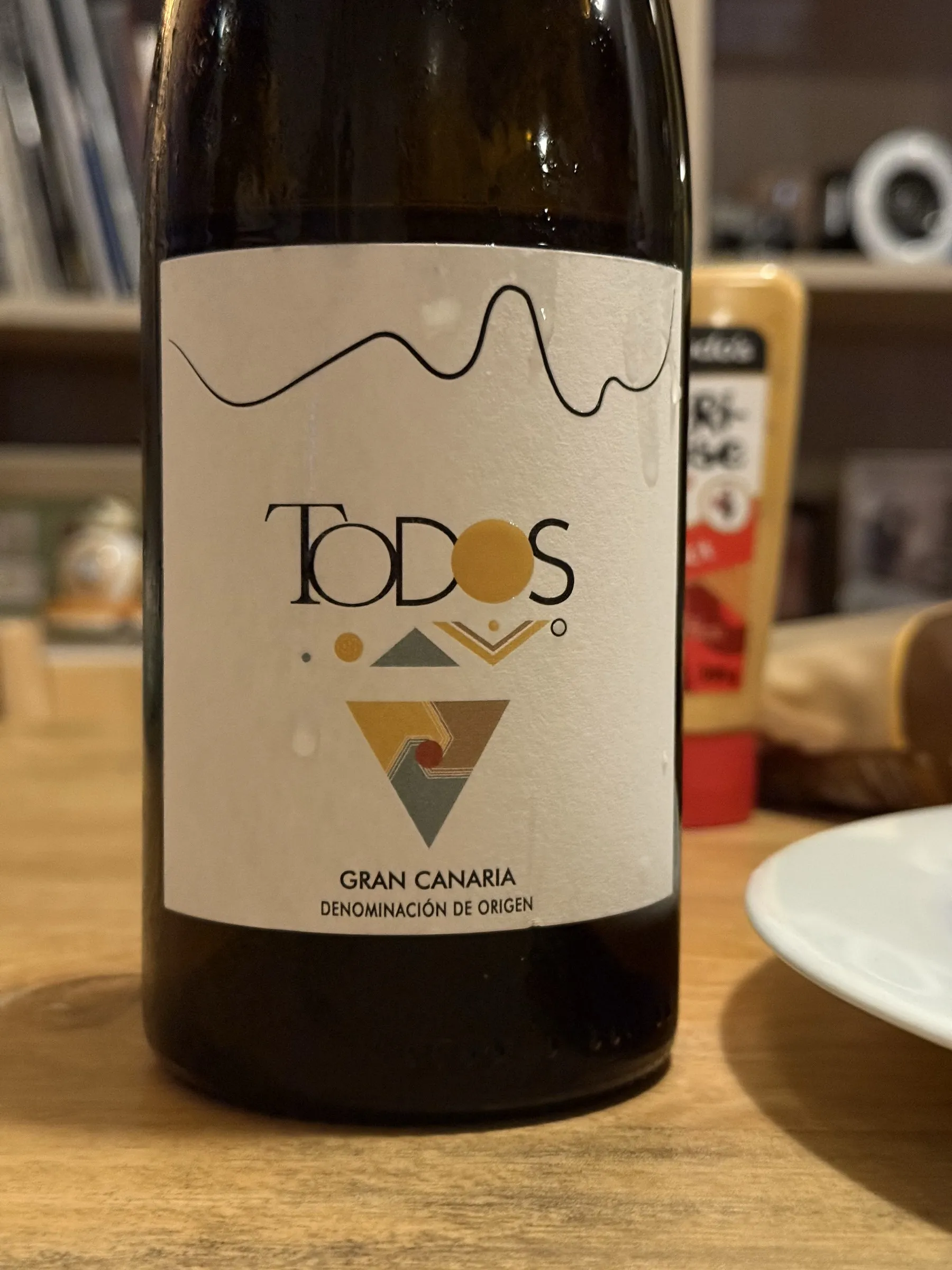
Three friends, a retired professor and the goddess Tara
Todos is a project run by three friends from the island, and the name pulls double duty: it means what it means, everyone, and it’s also the initials of the three of them. The label finishes the job with an inverted triangle, which isn’t a designer’s whim. It’s the symbol the island’s original inhabitants associated with Tara, their goddess of fertility: a womb holding everything you need for anything to grow here, meaning sun, ocean, soil, volcano and wind. (Canarios, mind, not guanches: the guanches were the Tenerife lot. It’s a personal bugbear and I intend to keep it.)
The estate, mind you, isn’t theirs by planting. It was built over twenty years ago by a retired university professor in a mountain village where nobody made wine and everybody grew fruit and vegetables. Putting vines in there was, generously, an eccentricity. Twenty years on the place has earned its spot on the island’s wine map, which is what happens now and again to eccentricities that stick around.
306 bottles on an island with 250 hectares
To make sense of the 306 you need to grasp how small Gran Canaria actually is as a wine region. The whole DO comes to about 250 hectares, roughly 230 of them registered, scattered across tiny plots in the midlands and the highlands that frequently share ground with potatoes or fruit trees. The 2024 harvest was 196,690 kilos of grapes across 85 growers and 34 wineries. On the Spanish mainland, that’s one mid-sized estate and that’s your lot.
With numbers like those, releasing 306 bottles of a given wine isn’t a marketing exercise in scarcity. It’s simply what there was. And it goes a long way to explaining why Gran Canaria gets talked about less than Tenerife and a good deal less than Lanzarote: the wine isn’t worse, it just barely leaves the island. And when it does leave these days, it heads for London before it heads for Madrid. If you want the full map of the islands, we lay it out in the Canary Islands wine guide.
Native grapes only (and the quietest one runs the show)
In the bottle there’s listán blanco, malvasía and a splash of vijariego blanco and Muscat of Alexandria. Four grapes from here and none from anywhere else, which in 2024 is still a choice rather than a given.
What hardly anyone knows about Gran Canaria is that its most planted white isn’t listán blanco, as it is across the rest of the archipelago, but Muscat of Alexandria, with vijariego hard on its heels. Which means that “splash” at the end of the list is precisely the bit that tastes of this island and no other. The muscat supplies the perfume without weighing down the palate (it’s vinified dry here, which is where it stops being pudding and gets interesting) and the vijariego holds the acidity up from underneath, which is its whole job: a stubborn grape that won’t let go of its acid for heat or humidity.
The tasting: an oxidative note having second thoughts
It’s light and easy going down, though there’s a bit of body behind it. The sort you drink without noticing until the bottle turns out to be half gone.
Then there’s the other thing, which is what actually caught my attention: it has an oxidative edge. Something that shows up without ever taking over, as if the wine were starting to consider being braver than it ends up being. It isn’t the note that defines it. It’s the one still rattling round your head after you’ve put the glass down.
In case the term’s new to you: oxidative is what you get when a wine has had controlled contact with air, and it reads as baked apple, nuts and something like orange peel drying in the sun. Pushed all the way it becomes an entire style (flor-aged wines, sherry). Here it’s a nod, and a welcome one.
What to drink it with?
Fish, and don’t overthink it. The vijariego’s acidity wants salt and lemon, and the oxidative edge appreciates a bit of fat opposite it: poached vieja (our parrotfish), something baked, papas arrugadas with green mojo. It handles a young local goat’s cheese well too. Don’t try it with red meat, which will walk straight over it.
I tasted the house Listán Negro as well, but the white wins that one comfortably. No argument.
It’s a good way into what’s being made on Gran Canaria right now, and hopefully it helps get us a bit better known. It all counts.
If one of the 306 crosses your path, don't think about it.
- Listán BlancoCanary Islands wine: where to start without getting lostVolcanic soil, grapes that exist nowhere else and a ladder that starts in a guachinche. How to get into Canary Islands wine without drowning in eleven appellations.
- Listán BlancoLorelay Toto 2024: a debut orange wine from Listán Blanco at 1,400 metresThree months on skins, ungrafted pre-phylloxera vines in Güímar and 386 numbered bottles. Starting a project on the top rung of the Canary Wine pyramid.
- Listán BlancoLos Loros La Bota de Mateo 2024: the Güímar Listán Blanco that turns up with an Andalusian accentUngrafted Listán Blanco from the Valle de Güímar, aged in an old manzanilla cask. Top marks from Tim Atkin and an Andalusian accent you never see coming.
- Canary IslandsListán Negro: the Canary red that changes its faceThe most planted red in the Canaries isn't one thing: it runs from light, fresh carbonic to serious oak-aged. What Listán Negro is and how to drink it.
- Canary IslandsVolcanic Malvasía: what it is and how it tastesA Canary-born cross of Malvasía Aromática and Marmajuelo, found nowhere else on earth. What Volcanic Malvasía is, how it tastes, and how it went from Shakespeare's wine to dry.
- Canary IslandsLanzarote wine: why La Geria tastes like nowhere elseVines in pits on volcanic ash, saline Malvasía and a streak of acidity you never see coming. An honest guide to why Lanzarote wine, and La Geria, tastes different.