Lorelay Toto 2024: a debut orange wine from Listán Blanco at 1,400 metres
Three months on skins, ungrafted pre-phylloxera vines in Güímar and 386 numbered bottles. Starting a project on the top rung of the Canary Wine pyramid.
A debut album. A debut bottle? Look, you know what I’m getting at.
Lorelay took the plunge with her own project and her first wine is finally out, the Toto 2024. I’ve been lucky enough to follow the whole thing step by step, mostly by pestering her about when the rest of us would get to taste it. “We’re picking.” “It’s in barrel.” “It’s bottled.” “I’m labelling it now.” “Yours is ready.” Months of that.
And you can tell, talking to her, that she’s poured herself into this heart and soul.
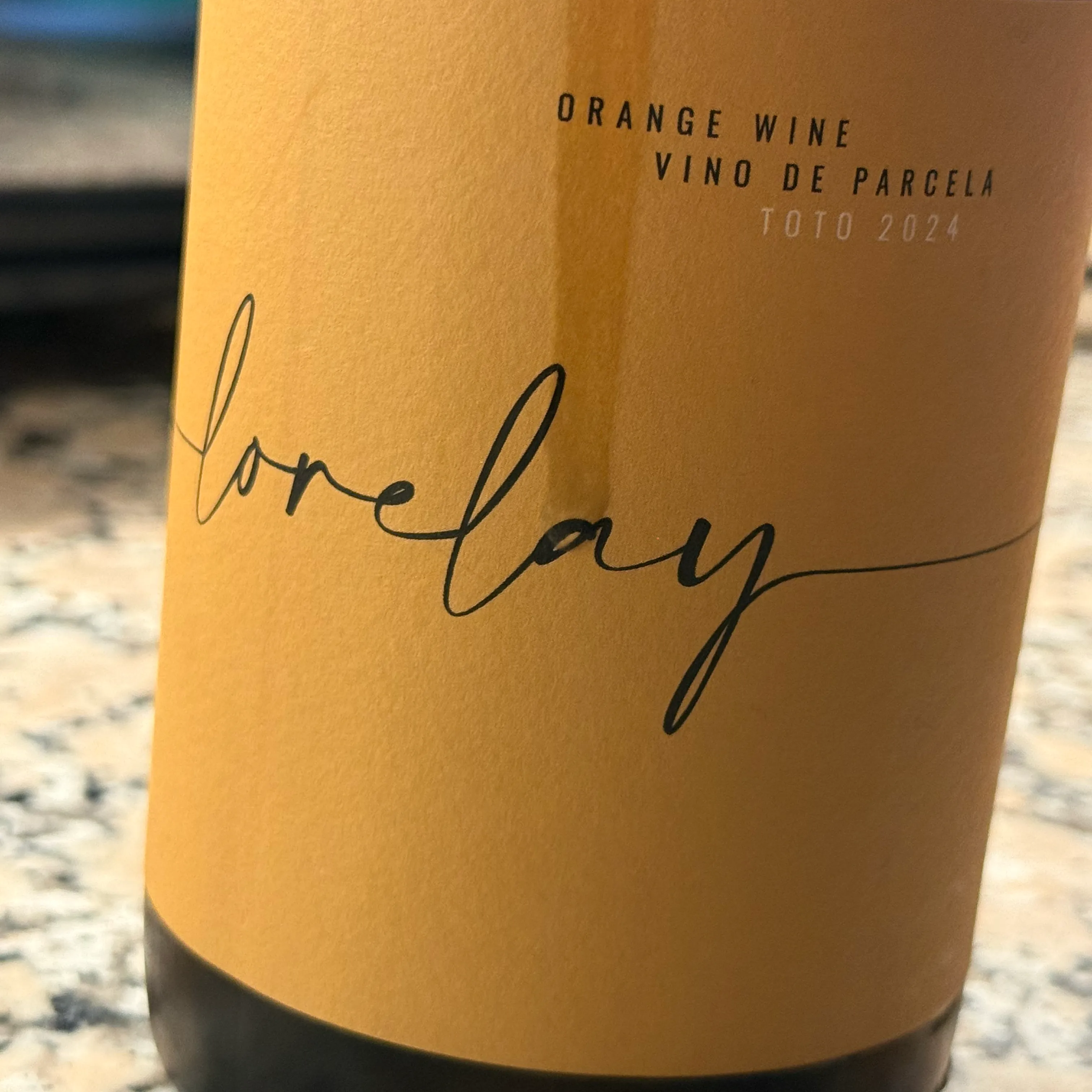
A single-parcel wine at 1,400 metres (and only 386 bottles)
Toto isn’t the name of the wine, it’s the name of the plot. It sits in Los Pelados, up in Güímar, at 1,400 metres, which on Tenerife is an altitude where hardly anyone is planting anything any more. Los Pelados and Las Dehesas are the two high corners of the valley, somewhere between 1,200 and 1,500 metres, and they count among the highest vineyards in Spain. Poor volcanic soils, stony, a bit of clay and a gradient that explains both why the picking was done by hand and why this ended up as 386 bottles rather than 3,860.
The vineyard is pre-phylloxera, ungrafted, growing on its own roots. Say that often enough in the Canary Islands and it starts to sound ordinary, but it’s worth remembering how rare it is worldwide: Listán Blanco vines of the kind phylloxera wiped off the rest of Europe over a century ago.
Then there’s the small print on the label, which is the best bit. It reads “Vino de Parcela con D.O.P. Islas Canarias”. A few years back the DOP Islas Canarias built itself an origin pyramid lifted straight from Burgundy: regional wine at the bottom, then island wine, then village wine, and right at the top the single-parcel wine, reserved for a plot whose soil and microclimate set it apart from everything around it. Lorelay has started her project on the top rung. With her first wine. Takes some bottle.
She describes her thinking without any frills: let the place speak, let the variety express itself freely, no recipes. In practice that means spontaneous fermentation with indigenous yeasts, three months macerating on the skins, four months on the lees, and minimal intervention everywhere else. Picked on 30 August 2024, in case anyone ever wants the detail.
And yes, if you go looking for this wine online you’ll find nothing at all. For now, this is all there is.
The tasting: unpeeled peach and Provençal herbs
The nose is peach and apricot, with Provençal herbs sitting behind them, already tipping you off about where this is heading. She talks about aniseed, fennel, dried apricots and a floral undertone, and she isn’t wrong, but what stayed with me was that cupboard of dried herbs poking out from under the fruit.
On the palate it’s exactly the texture of an unpeeled peach, fuzz and all. Light on its feet, fresh, long and properly mineral, with the acidity sitting precisely where it ought to. And back come the fennel and the oregano.
That fuzz is no accident: it’s the three months on skins. An orange wine isn’t a white with a tan, it’s a white raised like a red, and what it gets out of that is a fine little tannin you notice more on the tongue than on the palate. Funny thing, though: the other Güímar Listán knocking about here, La Bota de Mateo, lands on peach skin too, by a completely different route. Same grape, same valley, two winemaking approaches with nothing in common, both arriving at the same fruit. The place must be saying something.
It’s drinking beautifully now, but there are years in it yet.
What to drink it with?
Things that can take the hit: aged cheeses, a meaty rice, pasta with something to say for itself, even red meat. That touch of tannin from the skins lets it sit at the table like a light red, and the acidity cuts through fat without breaking a sweat. Serve it between 10 and 13 degrees, no colder, or you’ll miss the herbs entirely.
Though, in all honesty, drink the first glass on its own and take your time over it. This one has things to tell you.
If you find it, grab two. (There are 386 bottles in total, so best of luck with that. I’ve already got my second one stashed away.)
If you find it, grab two.
- Listán BlancoLos Loros La Bota de Mateo 2024: the Güímar Listán Blanco that turns up with an Andalusian accentUngrafted Listán Blanco from the Valle de Güímar, aged in an old manzanilla cask. Top marks from Tim Atkin and an Andalusian accent you never see coming.
- Listán BlancoTodos Blanco 2024: the Gran Canaria white you'll struggle to find306 bottles of a Gran Canaria white made from listán blanco, malvasía, vijariego and muscat. Light, easy, with an oxidative edge that shows up without taking over.
- Listán BlancoCanary Islands wine: where to start without getting lostVolcanic soil, grapes that exist nowhere else and a ladder that starts in a guachinche. How to get into Canary Islands wine without drowning in eleven appellations.
- Canary IslandsListán Negro: the Canary red that changes its faceThe most planted red in the Canaries isn't one thing: it runs from light, fresh carbonic to serious oak-aged. What Listán Negro is and how to drink it.
- Canary IslandsVolcanic Malvasía: what it is and how it tastesA Canary-born cross of Malvasía Aromática and Marmajuelo, found nowhere else on earth. What Volcanic Malvasía is, how it tastes, and how it went from Shakespeare's wine to dry.
- Canary IslandsLanzarote wine: why La Geria tastes like nowhere elseVines in pits on volcanic ash, saline Malvasía and a streak of acidity you never see coming. An honest guide to why Lanzarote wine, and La Geria, tastes different.