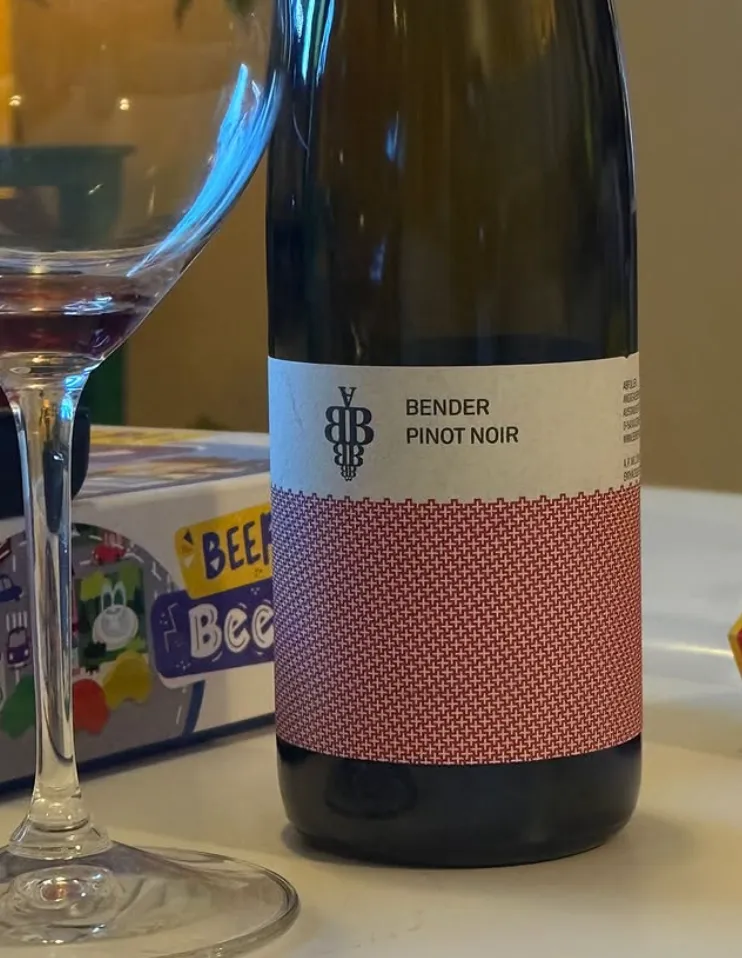
Andreas Bender Pinot Noir 2024: the Spätburgunder that turns up playful
Fresh raspberry and blackberry, a delicate floral lift and silk-fine tannins. Andreas Bender's Pfalz Pinot Noir, at a price that's frankly embarrassing.
A few months back I went to a tasting with Álvaro Ribalta and came away with three bottles under my arm. Couldn’t be helped.
One of them was this: the Andreas Bender Pinot Noir 2024, from western Germany. It comes in through Massal Selection, the import outfit Ribalta set up himself (he’s a Master of Wine, by the way), and it’s finally making its way around the Canaries. I’d been waiting a good while for that.
Germany is the world’s third-biggest Pinot Noir producer
Yes, Germany. Behind France and the United States, and ahead of whichever country you were about to name. In 2023 there were 11,519 hectares of Pinot Noir planted there, roughly 11% of their entire vineyard. The snag is that they call it Spätburgunder, “the late Burgundian”, and with a name like that you’re not shifting much abroad.
This bottle comes from the Pfalz, Germany’s second-largest wine region at around 23,500 hectares, some 1,760 of them Pinot Noir. It’s warm and dry, sheltered from the Atlantic by the Haardt hills, so red grapes ripen there without a struggle. The plot this comes from faces south, right on the slopes of those hills.
Behind it is Andreas Bender, born in Leiwen in 1980, deep in the Mosel, son of a vine nurseryman. He made his first wine at 13 in the family basement (at that age I was up to other things), studied at Geisenheim, Germany’s wine university, and after stints in cellars across France, Italy and the US he set up on his own in 2008. He still makes Riesling on the Mosel, but for the reds he heads down to the Pfalz, where the sun does its bit.
The recipe doesn’t shout either: wild-yeast fermentation in already-used barrels, then ageing in a mix of French and American oak. No new wood piled on. Which is why the spice and the chocolate on the palate turn up late and on tiptoe, instead of parking themselves in front of the fruit the way they do in so many reds with a bigger barrel budget than ideas.
The tasting: fresh raspberry and silk-fine tannins
The nose is raspberry and blackberry, but fresh and tart, just-picked, nothing jammy about it. Over the top there’s a delicate floral note that lifts the lot and gives it a cracking finesse. Clean, straightforward, no weight to it, not a note out of place.
The palate is enveloping and light and flowing all at once, which isn’t a combination you meet every day. The spice comes through bit by bit, in its own time, and behind it a hint of chocolate that never quite moves in: pokes its head round the door, sees there are people in, backs out again. The acidity is playful (not the sort that cuts you, the sort that nudges you in the ribs) and the tannin is very, very fine. Silk.
If light reds are your thing, this one plays in the same league as Canary Listán Negro: pale in colour, fresh in fruit, and forever angling for another glass.
What to drink it with?
Fish, and that’s the fun of it. It’s light enough to sit next to grilled tuna or oily fish off the coals without smothering them, and tasty enough to handle mushrooms, a roast chicken or a plate of ham. With cheese, go semi-cured rather than the real bruisers.
And serve it cool, around 14°C. At summer room temperature it loses exactly the thing that makes it dance. Same advice I give for the DePaula and La Pebrella: light reds get better when you knock a couple of degrees off them.
I left that tasting with three bottles under my arm. That was four months ago and I’m on seven: knees-ups, barbecues, tastings and a few just to open quietly at home.
Unbeatable for the money.