La Pebrella 2023 by Celler del Roure: 96 Parker points and not an ounce of weight
Arcos and Forcallà from Moixent, aged in buried clay jars. The lightest, most drinkable red I have had in ages, with 96 Parker points behind it.
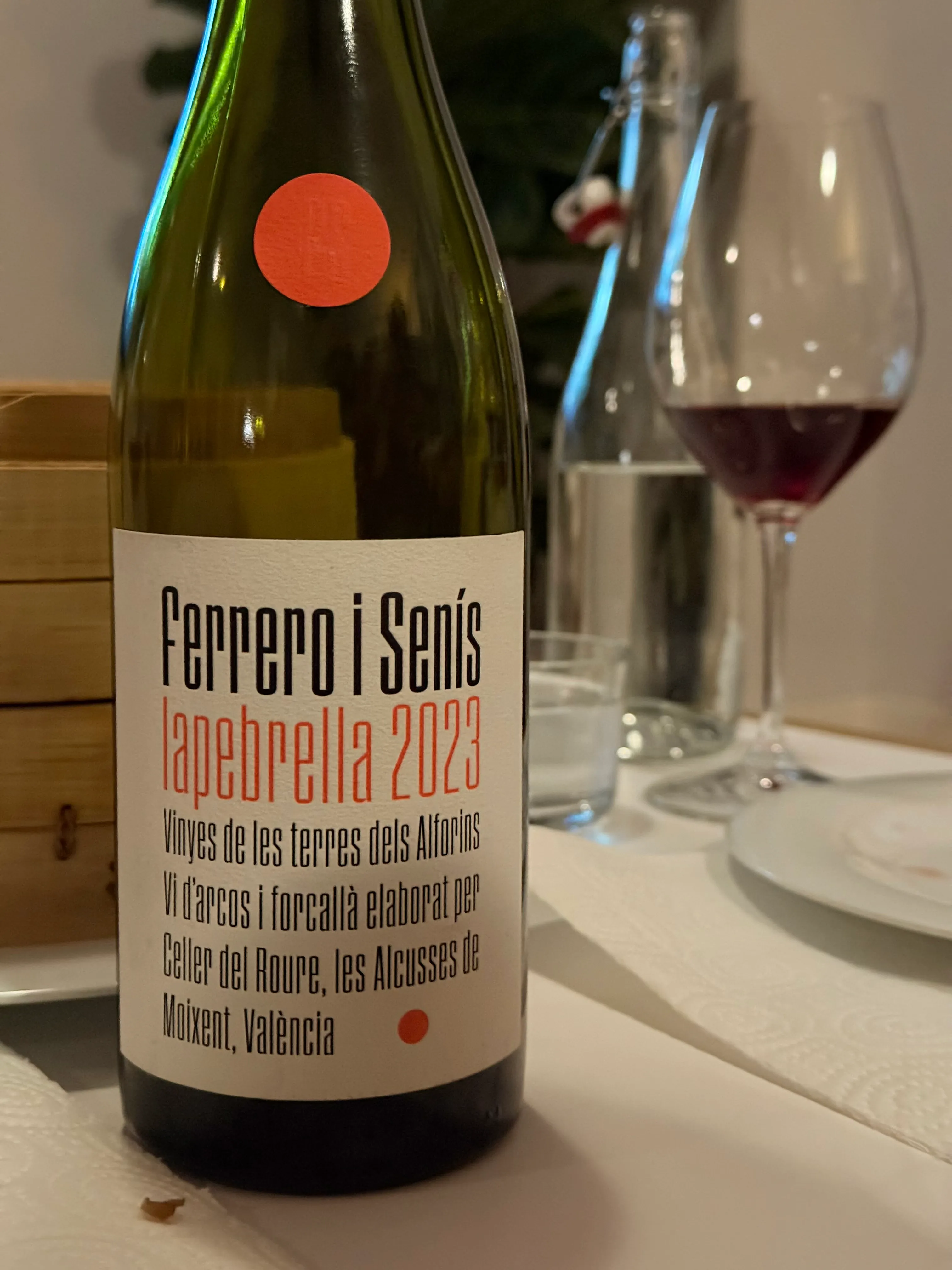
I’d been itching to try this one for ages. I’d seen it everywhere (in shops, on lists, on the phone of half the wine world) and somehow never got round to opening it. So when a La Pebrella 2023 from Celler del Roure (@cellerdelroure) finally came within reach, I ordered it without a second thought.
Two reasons, really. I’m a fan of this house’s Vermell, and I wanted to see what 96 Parker points actually meant on one of their wines. I’ll save you the suspense: it delivered.
Arcos and Forcallà: the grapes nobody wanted because they gave too little colour
Let’s start with the odd bit. La Pebrella isn’t Tempranillo or Monastrell or anything anyone will recognise: it’s half Arcos and half Forcallà, two native reds from the Terres dels Alforins, that inland Valencian plateau at 600 metres they like to call the Valencian Tuscany. The Arcos comes off a sandy plot; the Forcallà off old bush vines planted where there’s more clay. Both sitting on limestone.
And both came within a whisker of dying out. Through the twentieth century, when the area lived off bulk wine and you got paid by alcohol and by colour, grapes that give little of one, little of the other and ripen late into the bargain were a straightforward miscalculation. They were grubbed up by the hectare. That they’re now the most valuable thing the area has is one of those ironies that’s a pleasure to tell.
The name comes from the land too: pebrella is a wild thyme endemic to these parts, with a fierce aroma, the sort that goes into the local potatoes and grilled meats. And Ferrero i Senís, the range this wine belongs to, is the winery’s tribute to two of its own pillars, the vineyard man and the winemaker. Putting your team’s surnames on your top wine tells you plenty about a place.
Seventeenth-century clay jars and an old stone press
Behind it all is Pablo Calatayud, who set up Celler del Roure with his father in the late nineties, coming from a furniture family rather than a wine one. He started the way everyone started back then (international grapes, new oak) until he decided it was neither his nor the place’s.
In 2006 the family bought a neighbouring estate and found a celler soterrani inside it: three underground galleries holding some ninety-six buried clay tinajas, built between the seventeenth and nineteenth centuries. They didn’t turn it into a museum. They put it back to work.
This wine comes straight out of there. The two grapes ferment separately in the cups, the old stone presses, half of it whole-cluster and on native yeast, fourteen days on skins, and then spend eleven months ageing underground in clay tinajas and glass demijohns. Not a splinter of new oak anywhere in the process. That’s why the fruit reaches the glass so clean: there’s nothing standing in front of it. They bottled 4,300 of them, it sits at 12.5% alcohol, and Luis Gutiérrez gave it those 96 points in The Wine Advocate, talking about finesse and elegance. For once, the score and the sensation agree.
The tasting: light doesn’t mean watery
This is one of the lightest, most drinkable wines I’ve had in a long time, and here’s the crucial part: without losing a scrap of flavour or aroma. That balance is razor-fine and you don’t come across it every day. You catch yourself grinning as you drink it, which is the best tasting note I can offer.
On the nose and in the mouth the fruit is in charge: blueberry and blackberry, black fruit straight off the bush, not a hint of jam. Behind it comes a soft acidity (the sort that nudges rather than bites) and a spiced note that pops up and steps aside again. It is tannic, a bit, but with such a short run that it adds rather than takes away: it wipes the palate clean and leaves you reaching for the next mouthful. In the glass the colour is pale, almost like a northern winter red, and coming from southern Valencia that’s more startling still.
What to drink it with?
Everyday food, and serve it cool, around 14 ºC. This is a red that doesn’t smother anything, so it handles what a normal red would choke on: grilled veg, a rice dish, oily fish, even a proper salad. And since it carries no weight, it’ll see out the whole meal without wearing you down. With cheese it leans towards the semi-cured rather than the real bruisers. If this league of reds that don’t flatten you is your thing, Ponce’s DePaula and the Andreas Bender Pinot Noir play in it too, though this one goes up a rung (and up in price with it).
I took far too long to open it. I won’t be leaving it that long again.
A cracker. Light on its feet doesn't mean short on depth.